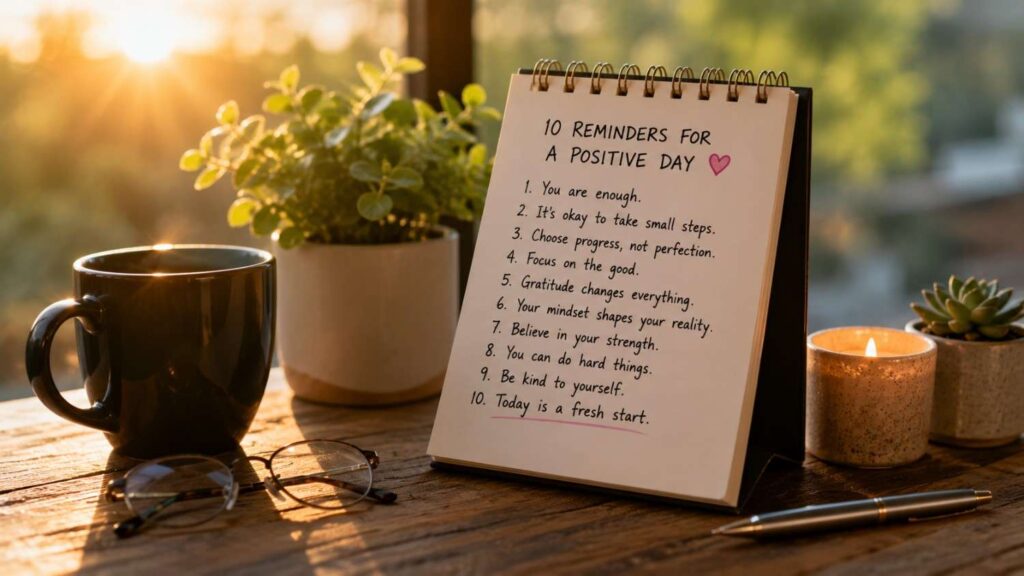
Top 10 Inspirational Quotes for a Positive Day: Meaning and Action
The Top 10 Inspirational Quotes for a Positive Day can help you begin the morning with intention instead of allowing your first notification, worry, or unfinished task to determine the direction of your thoughts. A carefully chosen quotation provides a brief mental pause in which you can decide how you want to respond.
Inspirational words should not be treated as a replacement for practical problem-solving, professional support, rest, healthcare, or difficult conversations. They are prompts rather than complete solutions. A useful quote may help you identify a more balanced interpretation, remember a personal value, or take the first step toward a task you have been avoiding.
This collection has been arranged as a progression. The opening quotes focus on new beginnings, active optimism, and the way interpretation shapes emotional experience. The middle selections explore meaning, purpose, practical action, and a more thoughtful definition of success. The final quotes address perseverance and the quiet endurance of hope.
Each section includes context, a clear explanation, and an action prompt. The purpose is not to collect ten attractive statements. It is to understand what each quotation can teach and decide when its message is appropriate.
In my experience, one well-chosen quotation applied during the day is more valuable than reading dozens of motivational sayings without reflection. Select the line that matches your current need. Keep it visible, translate it into your own words, and connect it to one behaviour.
| Quote Theme | Best Used When | Practical Response |
|---|---|---|
| New beginnings | The morning feels repetitive or unimportant | Identify one meaningful opportunity in the day |
| Optimism | Discouragement is reducing effort | Choose one hopeful but realistic action |
| Perspective | A situation feels emotionally overwhelming | Separate the event from your interpretation |
| Thought patterns | Negative assumptions are taking control | Test whether another interpretation is possible |
| Hope | Circumstances feel difficult | Notice one source of possibility |
| Purpose | Work feels disconnected from meaning | Identify the value behind the task |
| Practical action | You feel stuck or underprepared | Begin with available resources |
| Resilience | Progress feels slow | Recognize obstacles already overcome |
| Perseverance | Avoidance is extending a problem | Take the smallest safe step forward |
| Enduring hope | Motivation is low | Protect one realistic reason to continue |
Quotes 1–3: Start With Perspective and Possibility
A positive day does not require denying disappointment, uncertainty, or practical difficulty. It begins with the willingness to notice that the current situation may contain more than the first emotional reaction suggests. Perspective creates room for action because it prevents one problem from defining the entire day.
The first three quotations focus on the value of the present, the practical role of optimism, and the distinction between events and the judgments we attach to them. Together, they offer a useful morning sequence.
Emerson encourages readers to treat the present day as worthy of attention rather than waiting for a future occasion to feel meaningful. Keller presents optimism as an active belief that supports achievement, not as passive confidence that everything will work out. Epictetus then invites readers to examine the ideas and assumptions that intensify emotional distress.
These messages should be used with care. Perspective does not make every circumstance acceptable, and optimism should not silence valid concern. The goal is to prevent automatic conclusions from narrowing the range of possible responses.
When reading this section, consider which of the three challenges is most relevant today. Are you overlooking the value of the present? Has discouragement reduced your willingness to act? Are assumptions creating more distress than the known facts?
Select one quotation and keep its action prompt simple. The purpose is to begin the day with a deliberate mental direction, not to create an unrealistic expectation of uninterrupted positivity.
1. Ralph Waldo Emerson on Beginning Again
“Write it on your heart that every day is the best day in the year.”
Emerson included this line in Society and Solitude while emphasizing the importance of the present hour. The statement is often used as a cheerful morning message, but its deeper value lies in its challenge to stop postponing attention and meaning.
It does not claim that every day will be equally comfortable, productive, or joyful. Some days contain disappointment, illness, conflict, or loss. The quote instead encourages readers to approach the day before them as something worthy of participation.
This perspective is useful when routine makes life feel repetitive. Waiting for a holiday, promotion, relationship milestone, or ideal set of circumstances can cause ordinary opportunities to pass unnoticed. A meaningful conversation, completed task, moment outdoors, or act of kindness may not appear dramatic, but it can still give the day value.
Action prompt: Write down one experience you want to create today. Make it realistic and observable. You might complete one delayed task, share a meal without checking your phone, take a restorative walk, or give another person your full attention.
2. Helen Keller on Active Optimism
“Optimism is the faith that leads to achievement.”
Helen Keller included this statement in her essay Optimism. Her understanding of optimism was not based on ignoring hardship. It reflected a belief that constructive action remains meaningful even when circumstances are difficult or outcomes are uncertain.
This is different from assuming that success is guaranteed. Active optimism says that effort, cooperation, learning, and courage may improve the situation. Without some belief in possibility, people may stop acting before they have tested available options.
The quote is useful when discouragement has reduced your willingness to begin. You may not feel confident that an application will be accepted, a conversation will go well, or a new habit will last. Optimism does not require certainty. It asks whether one reasonable action is still worth attempting.
A balanced approach should include evidence and realism. If a strategy repeatedly fails, optimism may involve seeking advice or changing direction rather than repeating the same method.
Action prompt: Identify one behaviour that would make a positive outcome more likely. Send the message, request help, practise the skill, revise the plan, or restart the routine at a manageable level.
3. Epictetus on Interpretation
“Men are disturbed, not by things, but by the principles and notions which they form concerning things.”
This translation appears in The Enchiridion of Epictetus. The statement does not mean that painful events are unreal or that people are responsible for every emotional reaction. It highlights the additional role of interpretation.
An unanswered email may become “They do not respect me.” One unsuccessful attempt may become “I always fail.” A delayed plan may become “The entire day is ruined.” In each example, the event is real, but the broad conclusion adds further distress.
This quote can help when your reaction feels stronger than the information currently available. Begin by listing what is known. Then identify assumptions, predictions, or permanent labels that have been added.
This practice should not be used to dismiss legitimate risks. A balanced interpretation may still conclude that a problem is serious or requires support. The aim is accuracy rather than artificial positivity.
Action prompt: Replace one absolute statement with a question. Instead of saying, “This will never work,” ask, “Which part is not working, what evidence do I have, and what information would help me decide what to do next?”
Related Articles
Quotes 4–6: Choose Your Thoughts and Purpose
The middle portion of the day often brings a different challenge from the morning. Initial motivation may fade, unexpected problems may appear, and routine work can begin to feel disconnected from a larger purpose. The next three quotations address these moments by examining interpretation, hope within imperfection, and the relationship between meaning and effort.
Shakespeare’s line encourages readers to notice how judgments shape experience. It should not be interpreted as a claim that every event is morally neutral. Its practical value lies in showing that the same inconvenience can produce different responses depending on the meaning assigned to it.
Oscar Wilde then holds difficulty and hope together. His image does not deny the “gutter”; it suggests that hardship and the ability to look beyond hardship can exist at the same time.
Steve Jobs turns attention toward meaningful work. His statement is often simplified into advice to find a perfect career, but a professional reading requires more nuance. Most work contains repetitive, difficult, or uncertain periods. Meaning can come from the people served, the skill developed, the problem solved, or the future opportunity supported by today’s effort.
Together, these quotes invite the reader to ask three questions. Am I interpreting this situation in the only accurate way? Can I acknowledge difficulty while protecting one source of hope? Which value or purpose is connected to the work in front of me?
Use the following explanations to choose a response that is truthful, practical, and appropriate to your circumstances.
4. William Shakespeare on the Meaning We Assign
“There is nothing either good or bad but thinking makes it so.”
The line is spoken by Hamlet in Shakespeare’s play. It is frequently quoted as a broad statement about positive thinking, but its practical usefulness depends on context. It should not be used to suggest that injustice, harm, or serious loss becomes acceptable merely through a change of attitude.
In ordinary situations, however, the quote reminds us that judgments can intensify an experience. A delayed train may become wasted time or an opportunity to prepare. A difficult correction may feel like humiliation or useful information. The facts remain the same, but the interpretation influences the available response.
Reframing should remain honest. The purpose is not to choose the happiest explanation. It is to identify an interpretation that is both accurate and constructive.
This technique is particularly useful when words such as “ruined,” “disaster,” or “pointless” appear automatically. Those labels may describe emotion more than reality.
Action prompt: Write three versions of the same event: your automatic interpretation, a neutral description containing only known facts, and a constructive interpretation. Compare them and select the version that supports the wisest next action without denying what happened.
5. Oscar Wilde on Looking Toward the Stars
“We are all in the gutter, but some of us are looking at the stars.”
This line appears in Oscar Wilde’s Lady Windermere’s Fan. Its emotional strength comes from holding difficult circumstances and hope in the same image. The speaker does not deny the gutter. The stars matter precisely because the surrounding conditions are imperfect.
This makes the quote useful on days when cheerful language feels unrealistic. You do not need to call the situation good. You can acknowledge exhaustion, disappointment, uncertainty, or grief while still noticing one source of beauty, possibility, connection, or meaning.
Balanced optimism differs from avoidance. Looking at the stars does not require ignoring what must be repaired in the gutter. It simply prevents the problem from becoming the only thing visible.
The quote can also remind readers that attention is limited. Continually reviewing everything that is wrong may leave no mental space for supportive relationships, available options, or small moments of relief.
Action prompt: Describe the current “gutter” honestly in one sentence. Then identify one “star”: a person who cares, an option that remains open, a lesson, a future goal, or a small source of beauty. Give both realities appropriate attention.
6. Steve Jobs on Meaningful Work
“The only way to do great work is to love what you do.”
Steve Jobs delivered this line during his 2005 Stanford commencement address. It is often presented as a simple instruction to pursue a passion, but that interpretation can feel unrealistic for people who cannot immediately change careers or who work primarily to meet essential responsibilities.
A more practical reading is to examine the connection between effort and meaning. Interest can support persistence, but meaningful work may still include repetition, uncertainty, difficult colleagues, or tasks that are not personally exciting.
Meaning may come from serving customers, supporting a family, developing expertise, solving a problem, or creating future options. A person may not love every part of a role while still valuing what the work enables.
The quote can also prompt an honest review. If work has felt empty for a long time, which changes are possible? Could responsibilities be redesigned, a new skill developed, or a longer-term transition planned?
Action prompt: Identify one element of today’s work that supports a person, principle, or future goal. Give that element a defined period of focused attention. Do not wait for motivation to appear before beginning; meaningful engagement often develops through action.
Quotes 7–8: Turn Inspiration Into Action
Inspiration is most valuable when it changes behaviour. A quotation may create a moment of confidence, but that feeling can disappear quickly when a task still appears complicated, resources remain limited, or progress seems slower than expected.
The next two selections provide a bridge from reflection to action. The first encourages readers to begin with their current abilities, resources, and circumstances. The second offers a more contextual way to measure achievement by considering the obstacles a person has navigated.
These messages are especially useful when perfectionism, comparison, or a lack of ideal conditions has created delay. People often wait to begin until they have more confidence, more knowledge, better equipment, a larger budget, or an uninterrupted period of time. Preparation may be necessary, but endless preparation can become a socially acceptable form of avoidance.
Comparison creates another difficulty. Visible outcomes do not reveal starting points, responsibilities, health conditions, social barriers, or the support available to each person. Measuring your progress against another person’s position can hide the distance you have already travelled.
The quotations in this section encourage practical movement without pretending that resources and obstacles do not matter. Starting with what you have does not mean ignoring what you need. Recognizing obstacles does not mean lowering every ambition.
The goal is to choose the next realistic action and evaluate success within an honest context. Use these ideas when you feel unprepared to start or when comparison has made your own progress appear insignificant.
7. Theodore Roosevelt’s Recorded Maxim on Starting Now
“Do what you can, with what you’ve got, where you are.”
Theodore Roosevelt included this saying in his autobiography and credited it to Squire Bill Widener of Virginia. The maxim challenges three common reasons for delay: waiting to become more capable, waiting for better resources, and waiting for circumstances to change.
It does not mean preparation is unnecessary. Some tasks require training, specialist equipment, professional advice, or financial resources. The message is most useful when you already have enough to begin a smaller version of the task but continue postponing action because conditions are not perfect.
Starting with available resources creates information. A first draft reveals what research is missing. A short practice session identifies the weakest skill. An initial conversation clarifies whether support is available.
Small beginnings also reduce emotional resistance. A task that feels impossible at full scale may become manageable when reduced to ten focused minutes or one clearly defined step.
Action prompt: Select one delayed goal and identify the smallest useful action possible with your current time, energy, knowledge, and tools. Draft one paragraph, organize one folder, research one requirement, or make one call. After completing it, decide what resource is genuinely needed next.
8. Booker T. Washington on Measuring Success
“Success is to be measured … by the obstacles which he has overcome while trying to succeed.”
Booker T. Washington expressed this idea in Up from Slavery while reflecting on education, inequality, work, and the barriers he encountered. The statement offers a more contextual measure of achievement than status, income, speed, or public recognition alone.
Two people may reach different positions while demonstrating similar courage and effort because their starting points and obstacles were different. Visible results do not show illness, financial pressure, discrimination, family responsibilities, lack of access, or previous setbacks.
This perspective can protect motivation when comparison becomes unfair. It does not require abandoning ambition or refusing to learn from people who are further ahead. It simply creates a more accurate understanding of progress.
The quotation is also useful when reviewing a difficult period. Survival, adaptation, recovery, and persistence may represent meaningful achievements even when the original goal remains incomplete.
Action prompt: List three obstacles you have already navigated. Beside each one, identify the capability it required, such as patience, negotiation, learning, courage, creativity, or recovery. Then choose one capability that can support your next goal. Recognizing growth is not complacency; it provides evidence that future progress is possible.
Quotes 9–10: Keep Going With Hope and Courage
Some challenges cannot be solved in a single day. They require repeated effort, uncomfortable conversations, professional assistance, recovery time, or the patience to continue without immediate evidence of success. During these periods, motivation may be inconsistent.
The final two quotations focus on perseverance and hope. Robert Frost’s line addresses the tendency to avoid a difficult path, while Emily Dickinson describes hope as something small but persistent that continues through storms.
Both quotations require careful interpretation. Perseverance should not be confused with forcing yourself through an unsafe or damaging situation. Sometimes the correct path involves rest, withdrawal, medical support, legal protection, or a complete change of direction. Moving “through” a problem may include asking for help or creating a boundary.
Hope should also remain realistic. It does not require certainty that the desired outcome will occur. It can exist as curiosity, faith, responsibility, love, or the belief that circumstances may change.
These quotes are particularly valuable when a challenge feels too large for dramatic motivation. They encourage the reader to focus on the next safe step and protect one meaningful reason to continue.
As you read, consider whether your current difficulty requires persistence, support, recovery, or a different route. Inspiration should improve judgment rather than override it.
The aim of this section is not to glorify struggle. It is to show that courage can be quiet, gradual, and supported by others. Continuing may mean taking one step today and another after sufficient rest.
9. Robert Frost on Moving Through Difficulty
“The best way out is always through.”
This line comes from Robert Frost’s poem “A Servant to Servants.” It is frequently used to encourage persistence, but it should not be interpreted as a demand to continue recklessly through every painful or unsafe circumstance.
A responsible reading is that avoidance often preserves uncertainty and anxiety. A necessary conversation, medical appointment, financial review, or manageable task may become more intimidating when it is postponed repeatedly.
Moving through the difficulty does not require solving the entire problem at once. It can begin by gathering information, asking for professional help, writing the first sentence of a difficult message, or naming the issue clearly.
The quote is less appropriate when “through” would mean remaining in danger, ignoring exhaustion, or refusing to reconsider an unsuitable goal. Courage includes changing direction when new evidence shows that the existing path is harmful.
Action prompt: Identify the smallest safe step that moves you toward resolution. Make the action specific enough to complete: schedule the appointment, list the questions, open the document, or contact the relevant person. Progress becomes less overwhelming when the path is divided into manageable stages.
10. Emily Dickinson on Enduring Hope
“Hope is the thing with feathers.”
This is the opening image of Emily Dickinson’s poem commonly titled “Hope.” The poem presents hope as something that continues singing through difficult conditions and asks for little in return.
Dickinson’s metaphor is powerful because the bird is small. Hope is not described as certainty, control, or dramatic confidence. It is an inner possibility that remains present even when circumstances are severe.
This interpretation can be useful when you do not feel energetic or optimistic. You may be unable to believe that everything will improve soon, but you can still protect one reason to continue. That reason might be love, responsibility, faith, curiosity, unfinished work, or the knowledge that situations change.
Hope should not prevent practical preparation. A hopeful person can still acknowledge risk, seek assistance, rest, or create an alternative plan.
Action prompt: Complete the sentence, “Even though this is difficult, I still hope that…” Then identify one behaviour that protects that possibility today. You might contact a supportive person, complete one essential task, attend an appointment, or allow yourself enough rest to continue tomorrow.
How to Turn Inspirational Quotes Into a Daily Practice
Reading daily motivational quotes can create a brief sense of encouragement, but that feeling often disappears once the reader returns to email, responsibilities, traffic, or an unresolved problem. A quote becomes more useful when it is connected to a repeatable routine and a visible behaviour.
Begin by choosing one quotation rather than attempting to absorb an entire collection. Selection matters because different messages serve different needs. Emerson may help when the day feels repetitive. Roosevelt may help when hesitation is the problem. Dickinson may be more appropriate when energy is low but hope still needs protection.
Place the chosen quote somewhere you will see it at the right moment. A journal, planner, desk card, phone background, or calendar reminder may work. Visibility alone is not enough, however. Add a short question that turns the quotation into a decision.
For example, beneath Roosevelt’s maxim, write: “What can I do with the next ten minutes?” Beneath Epictetus, write: “What are the facts, and what have I assumed?”
Review the result later. Did the quote change an interpretation, conversation, or action? If not, the quotation may have been too general or unrelated to the day’s actual challenge.
A daily practice should remain flexible. You do not need to use the same quote every morning or create a lengthy journaling ritual. The objective is to build a reliable connection between inspiring language and intentional behaviour.
The following two methods provide a simple structure that beginners can adopt immediately and experienced readers can adapt to more complex goals.
Reading a variety of daily inspirational quotes can also help you discover messages that align with your current goals before turning one into a practical daily habit.
| Daily Situation | Recommended Quote Author | Core Message | Best Daily Application |
|---|---|---|---|
| Starting a new day | Ralph Waldo Emerson | Value the present moment | Begin the day with one meaningful goal |
| Feeling discouraged | Helen Keller | Optimism supports achievement | Take one positive action instead of giving up |
| Overthinking a problem | Epictetus | Separate facts from assumptions | Reframe negative thoughts objectively |
| Losing motivation | Steve Jobs | Connect work with purpose | Focus on meaningful progress rather than perfection |
| Facing setbacks | Robert Frost | Move through challenges | Break difficult tasks into manageable steps |
| Needing hope | Emily Dickinson | Hope remains during difficult times | Stay committed to one positive possibility |
Create a Three-Minute Morning Quote Routine
A three-minute routine is long enough to create reflection but short enough to repeat on busy mornings. Begin by reading one quote slowly rather than scanning several. Pay attention to the specific words that feel relevant.
Next, rewrite the message in your own language. This step confirms that you understand the idea rather than responding only to familiar wording. Emerson’s message might become, “Today deserves my attention before I know whether it will be easy.”
Identify the situation in which the quote matters. You may need the message during a meeting, a difficult task, a commute, or a conversation. Then choose one related behaviour.
A complete routine can follow five steps:
- Read one quotation slowly.
- Rewrite its meaning in one sentence.
- Identify where it applies today.
- Select one observable action.
- Review the action in the evening.
Keep the action realistic. A quote about purpose does not require changing careers before lunch. It may lead to one hour of focused work or a conversation about future development.
The routine should not suppress emotion. You can acknowledge sadness, worry, or frustration while choosing a constructive response. The goal is not a perfect mood; it is a deliberate direction.
Use an If-Then Action Plan
An if-then plan connects a likely situation with a predetermined response. This structure is often described as an implementation intention. Instead of relying on motivation in the moment, you decide in advance what you will do when a particular cue appears.
For example:
- If I begin comparing my progress with someone else, then I will review Washington’s quote and list one obstacle I have overcome.
- If I delay starting, then I will use the Roosevelt maxim and work for ten minutes.
- If a setback feels permanent, then I will use Epictetus’s idea to separate facts from assumptions.
- If I feel discouraged, then I will identify one “star” from Wilde’s quotation.
The response should be observable. “I will think positively” is difficult to measure. “I will write one alternative interpretation” is clear.
Choose situations that occur regularly. A plan linked to a predictable cue is easier to remember than a general intention.
Review the plan after several days. If it is not being used, the cue may be unclear or the response may be too demanding. Adjust it until the behaviour can happen under real conditions.
Quick Answer About Top 10 Inspirational Quotes for a Positive Day
The Top 10 Inspirational Quotes for a Positive Day can help you pause, reconsider a stressful situation, and choose a constructive response before the day becomes shaped by worry, frustration, or distraction. The most useful quotations do more than create a brief emotional lift. They offer a memorable principle about hope, perspective, meaningful work, resilience, or action.
This collection includes verified words associated with Ralph Waldo Emerson, Helen Keller, Epictetus, William Shakespeare, Oscar Wilde, Steve Jobs, Theodore Roosevelt, Booker T. Washington, Robert Frost, and Emily Dickinson. Each quotation is followed by an explanation and a practical action prompt.
To benefit from these words, do not simply read all ten and move on. Select one quote that matches your current challenge. Rewrite its meaning in your own words, identify one behaviour that expresses the idea, and review the result later in the day. A quotation cannot remove every problem, but it can interrupt unhelpful thinking and help you respond more deliberately.
The purpose of daily inspiration is not to force a cheerful mood. It is to create enough perspective to make one thoughtful decision, complete one meaningful action, or preserve one reason for hope.
What Makes an Inspirational Quote Useful?
A useful inspirational quote is memorable enough to return to during a difficult moment and specific enough to influence a real decision. General statements about happiness may feel pleasant, but they are less valuable when they do not help the reader interpret a challenge or decide what to do next.
The strongest quotations usually express a principle. They may encourage the reader to value the present day, separate facts from assumptions, begin with available resources, continue through uncertainty, or recognize hope within imperfect circumstances. Because the language is concise, the message can be recalled when longer advice would be difficult to remember.
Context also affects usefulness. A quote about persistence may help when avoidance is delaying a necessary task. It may be less appropriate when exhaustion indicates a genuine need for rest. Similarly, a quote about optimism should not be used to dismiss grief, anxiety, or practical obstacles.
After reading a quotation, ask: “What would this idea look like in my behaviour today?” Your answer might involve beginning a delayed task, asking for help, revising an assumption, showing appreciation, or setting a healthy boundary. The quote becomes useful when it moves from decoration to reflection and from reflection to action.
If you enjoy exploring different perspectives, these personal growth quotes provide additional examples of how short, meaningful statements can encourage reflection and lasting personal development.
Why Verified Attribution Matters
Verified attribution matters because famous quotations are frequently shortened, modernized, combined with other sayings, or assigned to people who never wrote or spoke them. Social media makes this problem worse because a visually appealing quote card can circulate thousands of times without including a source.
Accurate attribution respects the original writer and helps readers understand the context. A sentence taken from a poem may have a different meaning when read beside the surrounding lines. A statement delivered in a commencement speech may reflect the speaker’s personal experience rather than a universal rule.
The Theodore Roosevelt selection in this article provides a useful example. Roosevelt recorded the words in his autobiography but identified them as a piece of practical philosophy spoken by Squire Bill Widener. Presenting the line only as a “Roosevelt quote” removes that detail and gives an incomplete impression of its origin.
Wording can also vary between editions and translations. This is particularly important for ancient writers such as Epictetus. When quoting translated work, the selected edition should be identified where possible.
Before publishing inspirational sayings, consult original books, official speech transcripts, recognized literary archives, or respected academic sources. Verification strengthens credibility and prevents a professional website from repeating attractive but unreliable material.
Frequently Asked Questions About Top 10 Inspirational Quotes for a Positive Day
Readers searching for the Top 10 Inspirational Quotes for a Positive Day often want more than a list of memorable sayings. They may be trying to choose one quote for a morning routine, understand whether motivational language can influence mindset, or confirm that a quotation has been attributed accurately.
Inspirational content can be helpful, but it is also easy to oversimplify. A brief sentence cannot resolve every emotional, professional, financial, or health-related difficulty. Its value lies in providing a compact perspective that can be connected to a practical response.
The quality of a quotation matters less than the way it is used. A famous line displayed on a wall may become invisible through familiarity. A less famous sentence connected to one meaningful habit may have greater influence.
Readers should also distinguish inspirational quotations from positive affirmations. A quotation expresses another person’s observation or idea. An affirmation is usually a personal statement about identity, values, or intended behaviour. Both may support reflection, but neither should require a person to deny legitimate emotions or practical barriers.
Attribution is another common concern. Short statements are easily misquoted because they circulate without sources. Verifying the original text protects accuracy and gives readers the opportunity to explore the wider work.
The following answers provide practical guidance for choosing, sharing, and applying motivational words responsibly. Each response emphasizes realistic action rather than passive inspiration.
What Is the Best Inspirational Quote to Read Every Morning?
There is no single quotation that is best for every person or every morning. The most useful choice depends on the challenge you expect to face.
Read Emerson when routine has made the day feel unimportant. Use Keller when discouragement is reducing your willingness to act. Roosevelt is helpful when perfectionism or limited resources have delayed a task. Frost may support a necessary step through avoidance, while Dickinson offers a quieter message when hope needs protection.
Choose the quote before the busiest part of the day. Rewrite it in your own words and connect it to one behaviour. A quotation about action might lead to ten minutes of focused work. A quotation about perspective might lead to writing the known facts before reacting.
The best morning quote is therefore not necessarily the most famous or dramatic. It is the one that accurately addresses your present need and produces a thoughtful response.
Change the selection when it no longer feels relevant. A flexible practice is more useful than repeating the same words automatically.
Can Inspirational Quotes Actually Change Your Mindset?
An inspirational quote can briefly interrupt an automatic thought and introduce another perspective, but one sentence is unlikely to create lasting mindset change by itself.
The effect becomes more meaningful when the quotation is repeated in an appropriate context and linked to behaviour. Epictetus’s words may encourage you to separate facts from assumptions. Roosevelt’s maxim may prompt you to begin with available resources. Washington’s idea may help you evaluate progress more fairly.
Mindset develops through repeated interpretation, action, feedback, and experience. A quote can support this process by making a useful principle easier to remember, especially during emotionally demanding moments.
However, quotations should not replace professional care, practical planning, education, or environmental change. A person experiencing severe distress or structural hardship needs more than motivational language.
Treat the quote as a cue rather than a solution. Ask what action would express its message and whether that action is safe, realistic, and relevant.
When words repeatedly guide better decisions, they may gradually influence habits of thought. Their power comes from application rather than repetition alone.
Are Inspirational Quotes the Same as Positive Affirmations?
Inspirational quotes and positive affirmations can both support reflection, but they are not the same.
A quotation presents another person’s observation, experience, or principle. It usually includes attribution and may come from a book, poem, speech, play, or philosophical text. Readers interpret the message and decide whether it applies to their circumstances.
A positive affirmation is generally a first-person statement repeated to reinforce a value, intention, or desired identity. Examples include, “I can respond calmly,” or “I am committed to learning from this experience.”
Both methods should remain credible. An affirmation that feels obviously false may create resistance. A quotation used without context may encourage oversimplification.
A practical approach is to combine them. Read Roosevelt’s maxim, then create the affirmation, “I can begin with the resources available today.” Read Dickinson, then write, “I will protect one realistic reason for hope.”
Neither method should be used to deny sadness, anxiety, exhaustion, or injustice. Their purpose is to support intentional thinking and behaviour, not to demand a permanently cheerful emotional state.
How Do I Choose a Quote of the Day?
Begin by identifying the main challenge or intention for the day. Do not select a quotation only because it is famous or visually attractive.
When procrastination is the main issue, choose a message about action. If worry is creating exaggerated conclusions, use a perspective-based quote. If comparison is reducing confidence, select Washington’s contextual view of success. When circumstances are difficult and motivation is low, Wilde or Dickinson may be more appropriate.
After selecting the quote, rewrite its meaning in one sentence. Then decide when you are most likely to need it. Place it where it will appear at that moment, such as beside a work screen, inside a planner, or in a phone reminder.
Add one action. A quote of the day should produce something observable: begin for ten minutes, contact someone, write one alternative interpretation, or identify one reason for gratitude.
Review the quote in the evening. If it did not influence anything, consider whether the message was too general or unrelated to your actual need. The right quote should feel relevant enough to guide a decision.
Can I Share These Quotes on Social Media?
Short quotations are commonly shared on social media, but they should be presented with accurate attribution and respectful context. Include the author’s name and, where practical, link to the original text or an authoritative source.
Avoid silently rewriting a quotation to make it more modern or concise. If you paraphrase the idea, label it as a paraphrase rather than placing the revised wording inside quotation marks.
Copyright status can vary according to the author, publication date, jurisdiction, amount used, and purpose. Many older works in this article are available through Project Gutenberg because they are in the public domain in the United States. More recent speeches and writings may still be protected.
A professional page should also avoid placing an author’s name beneath a saying simply because the attribution is popular. Verify the line before creating graphics or captions.
When sharing, add your own brief interpretation rather than posting the quotation without context. Explain why the words matter, ask a reflective question, or connect the message to an action. This provides original value and reduces the risk of turning meaningful writing into empty decoration.
Why Are Some Famous Quotes Misattributed?
Famous quotations are often misattributed because short, memorable statements spread more quickly than source information. A line may be copied from one website to another until the original context disappears.
Some quotations are paraphrases of longer passages. Others combine ideas from multiple authors or use modern language that the alleged speaker would not have used. Attaching a respected name can also make an anonymous saying appear more authoritative and shareable.
Translations create another source of variation. Ancient philosophical works may appear in several legitimate English versions, each using different wording. In these cases, identifying the edition or translator is more accurate than claiming one modern phrase is the only correct form.
Verification requires more than searching for the quote beside an author’s name. Look for the words in original books, official speech transcripts, literary archives, university collections, or scholarly quotation references.
If a reliable source cannot be found, present the attribution cautiously or omit the quotation. Accuracy is especially important for educational and professional websites because repeated errors weaken reader trust.
A well-sourced collection may include fewer quotes, but it provides greater long-term value.
Conclusion
The Top 10 Inspirational Quotes for a Positive Day offer ten different ways to approach the emotional and practical demands of daily life. Emerson emphasizes the value of the present. Keller connects optimism with constructive effort. Epictetus and Shakespeare encourage readers to examine the interpretations that shape emotional experience.
Wilde protects hope without denying difficulty, while Jobs invites a deeper examination of purpose and meaningful work. Roosevelt’s recorded maxim encourages action with available resources. Washington provides a more contextual understanding of achievement by considering the obstacles a person has overcome.
Frost addresses the need to move gradually through difficulties that avoidance cannot solve. Dickinson closes the collection with an image of hope that is quiet, persistent, and capable of remaining present through a storm.
These quotations should not be treated as universal instructions. Different situations require different responses. A message about persistence may be useful when hesitation is the problem, but rest or professional support may be more appropriate when safety or health is involved.
The most effective practice is to select one quote rather than trying to remember all ten. Translate its meaning into your own words and connect it to one action that fits your circumstances.
A positive day is not necessarily a day without frustration, sadness, mistakes, or uncertainty. It is a day in which at least one response is chosen deliberately rather than automatically. Inspirational words can support that process when they lead to accurate reflection, practical action, and realistic hope.
| Daily Practice Step | Purpose | Expected Benefit |
|---|---|---|
| Read one inspirational quote | Create a positive focus | Improve daily mindset |
| Reflect on its meaning | Connect the message to real life | Build self-awareness |
| Choose one practical action | Turn inspiration into behavior | Encourage consistent progress |
| Apply the lesson during the day | Reinforce positive habits | Increase motivation and resilience |
| Review your results in the evening | Measure personal growth | Develop a sustainable positive routine |
Choose One Quote, Not All Ten
Reading all ten quotations can provide variety, but lasting value usually comes from selecting one message and applying it repeatedly.
Begin with the challenge that is most present. If the morning feels repetitive, choose Emerson. If hesitation has delayed an important task, use Roosevelt. When comparison makes progress feel insignificant, Washington may provide a more accurate standard. If circumstances are difficult and energy is low, Dickinson may offer a gentler form of encouragement.
Write the quotation in a journal, place it beside your workspace, or schedule it as a reminder before the moment when you are most likely to need it.
Then add one behaviour. The action should be small enough to complete and clear enough to review. You might work for ten minutes, write the facts of a situation, contact a supportive person, or identify one source of hope.
In the evening, ask whether the quote influenced a decision, interpretation, or conversation. If it did not, choose another message or create a more specific action.
The goal is not to build the largest quotation collection. It is to develop a small number of principles that become associated with useful habits.
Use Inspiration as a Beginning
Inspiration is most valuable as the beginning of a process rather than its final result. A moving sentence may create energy, but energy without direction often fades.
Use a quotation to pause and identify what matters. Then translate its principle into a question. Emerson may become, “How will I give this day my attention?” Epictetus may become, “What do I know, and what have I assumed?” Roosevelt may become, “What can I do with what is available?”
The next step is action. Choose a response that is safe, realistic, and within your influence. It may be small, but it should be observable.
Over time, certain quotes may become linked to specific situations. One may help during comparison, another during procrastination, and another during uncertainty. This creates a personal library of practical reminders rather than passive motivational content.
Do not expect inspiration to remain constant. Build routines that can continue when motivation is low. A quote may open the door, but repeated behaviour creates progress.