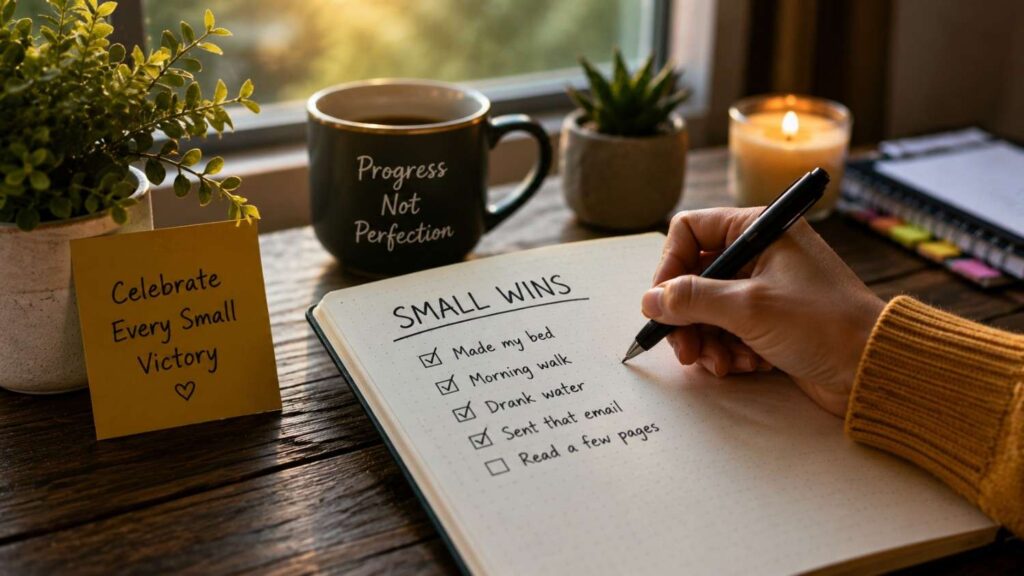
How to Celebrate Small Wins Every Day: A Practical Guide
Large achievements receive most of the public attention, but they are usually built through small actions that happen without applause. A completed paragraph contributes to a book. A ten-minute walk supports a longer health routine. One honest conversation can begin to repair a relationship. A single application, lesson, practice session, or budget review can move a larger goal forward.
Learning how to celebrate small wins every day means developing a reliable way to notice those actions before the final result arrives. This is not about exaggerating ordinary tasks, lowering standards, or treating productivity as the measure of a person’s worth. It is about recognizing progress that supports your goals, values, well-being, responsibilities, or personal development.
Research on progress monitoring provides a useful foundation for this practice. A meta-analysis of 138 studies found that interventions designed to increase progress monitoring promoted goal attainment. The effects were stronger when people physically recorded progress or made it public.
Other research suggests that the relationship between progress, confidence, and commitment can work in more than one direction. A multi-wave study of academic and interpersonal goals found that within-person goal progress predicted later goal commitment and self-efficacy, while depressive symptoms and goal-related beliefs also interacted over time. The findings apply to the goals and participants studied rather than proving a universal formula.
The practical lesson is straightforward: what you repeatedly notice becomes easier to evaluate. A small-win routine gives you evidence of completed work, highlights effective strategies, and makes it easier to decide what to do next.
The following guide explains why small wins matter, what should count as progress, how to celebrate constructively, and how to continue after setbacks.
Why Celebrating Small Wins Matters
Celebrating small wins matters because long-term goals often provide very little immediate feedback. A qualification may take years, a business may take months to stabilize, and a health habit may require consistent effort before visible changes appear. When success is measured only by the final outcome, most days can feel unsuccessful even when useful work is happening.
Small milestones create intermediate evidence. They show that you began, practiced, learned, finished a component, solved a problem, or returned after an interruption. That evidence can make an abstract goal feel more concrete and help you judge whether your current strategy is producing movement.
The idea connects with work by Teresa Amabile and Steven Kramer, whose Progress Principle examined how progress in meaningful work related to employees’ emotions, perceptions, motivation, engagement, and creativity. Their conclusions came from workplace research, so they should not be presented as proof that every personal accomplishment produces an identical psychological response. The work nevertheless highlights how easily everyday progress can be overlooked and how meaningful it can become when recognized.
Celebration also creates a deliberate transition between completion and the next demand. Without that pause, a finished action can disappear from awareness as soon as another responsibility appears. The person remains focused on what is missing and develops the inaccurate impression that little has been achieved.
The strongest small wins are connected to meaningful goals. Completing an easy but unimportant task may feel satisfying, yet it should not replace progress on a higher-priority responsibility. Recognition works best when it is paired with honest evaluation: What changed, why did it matter, and what should happen next?
Small Wins Make Progress Visible
Long-term goals often conceal the amount of work already completed. A person writing a book may look only at the unfinished manuscript and overlook weeks of research, planning, and drafting. Someone learning a language may focus on fluency while forgetting that they can now understand material that was confusing several months earlier.
Recording a small win converts effort into visible evidence. Instead of relying on memory, which may be influenced by current mood or frustration, you create a factual record of what changed. “Worked on the project” remains vague. “Drafted the first 400 words and identified two missing sources” describes progress that can be evaluated.
Research on goal monitoring supports this practice. The meta-analysis by Harkin and colleagues found that increasing the frequency of progress monitoring promoted goal attainment, with larger effects when progress was physically recorded or reported publicly.
Visible progress also improves planning. If your journal shows repeated effort without movement toward the desired result, that pattern may indicate a need for feedback, a different method, a smaller milestone, or a revised goal.
Celebration should therefore include both recognition and information. A useful entry says, “This action moved me forward, and here is what I learned from it.” That approach builds awareness without turning a progress log into automatic praise.
Recognition Can Support Confidence and Motivation
Self-efficacy refers to a person’s belief that they can perform a particular action or manage a challenge. Confidence becomes more reliable when it rests on concrete experience rather than broad affirmations.
A completed action can provide that evidence. Making a difficult call shows that you can act while nervous. Returning to a routine demonstrates that one interruption does not have to become permanent. Requesting feedback shows that you can tolerate uncertainty and use new information.
Research has linked goal progress with later self-efficacy and commitment in specific academic and interpersonal contexts. Experimental work has also found that positive feedback affected task-specific self-efficacy, which then mediated effects on flow and subsequent task performance in a mental-arithmetic study. These findings do not prove that praise always improves performance; they suggest that accurate feedback can influence how capable a person feels in a particular setting.
Recognition is therefore most useful when it is specific. Replace “I am successful” with “I prepared thoroughly and answered the difficult questions.” Replace “I am disciplined” with “I completed the planned session even though my schedule changed.”
This language connects confidence to repeatable behavior. It helps motivation because it identifies the action that can be performed again, improved, or adapted.
Positive Experiences Are Easier to Remember When You Savor Them
Savoring means deliberately attending to a positive experience so that it is not immediately replaced by the next task, worry, or notification. It can involve noticing satisfaction, describing the moment, sharing it, or recalling it later.
A 2026 systematic review and meta-analysis examined randomized controlled trials of savoring interventions and reported benefits across positive-emotion and well-being outcomes. The results should be interpreted according to the quality and diversity of the included studies, but they support the idea that deliberately engaging with positive experiences can have value.
A small-win celebration offers a simple opportunity to practice savoring. After completing a meaningful task, pause for several breaths. Look at the finished work. Say, “That step is complete.” Notice any relief, pride, satisfaction, or gratitude without trying to manufacture a dramatic emotional reaction.
Savoring can also be social. You might tell a colleague that a difficult stage is finished, send a supportive friend a brief update, or thank someone who helped. The purpose is not to seek constant approval. It is to give the accomplishment enough attention to become part of your remembered experience.
Quiet satisfaction counts. A celebration does not need to be energetic, public, expensive, or visible online. Its value comes from recognizing completion before attention moves elsewhere.
What Counts as a Small Win?
A small win is a completed action, useful decision, meaningful effort, lesson, or measurable improvement that moves an important part of life forward. It may relate to health, work, education, relationships, creativity, finances, emotional well-being, caregiving, or household responsibilities.
The size of a win depends on the person and situation. Making an appointment may be routine for one reader and a major act of courage for someone managing anxiety. Taking a rest day may look unproductive from the outside but represent progress for a person learning to recover properly. Saying no to an unreasonable request may be a meaningful milestone for someone developing healthier boundaries.
Wins do not have to involve a successful external outcome. You cannot fully control whether you receive an offer, win a competition, or receive a positive response. You can recognize preparing carefully, submitting your work, asking the necessary question, or applying what you learned.
A useful distinction is between outcome wins and process wins. Outcome wins involve a completed result. Process wins involve behaviors that improve the probability of progress, such as practicing, planning, requesting feedback, or correcting an ineffective method.
The table below shows how ordinary actions can be framed without exaggeration:
| Area | Possible Small Win | Simple Celebration |
|---|---|---|
| Work | Completed a difficult first draft | Take a short break and mark it complete |
| Health | Walked for ten minutes | Listen to a favorite song |
| Learning | Practiced a skill for 20 minutes | Record what improved |
| Relationships | Started an honest conversation | Share appreciation with the other person |
| Finances | Reviewed one bill or expense category | Update the tracker and enjoy a relaxing activity |
| Well-being | Asked for support | Write why the action required courage |
| Home | Cleared one cluttered surface | Enjoy the improved space |
| Creativity | Finished a sketch or paragraph | Save it in a progress portfolio |
Celebrate Effort, Learning, and Courage
Outcomes are important, but they are not always fully under your control. A strong small-win practice therefore recognizes controllable behaviors such as preparation, persistence, honest communication, experimentation, and recovery.
Effort alone should not be celebrated automatically. Repeating an ineffective method without reflection may consume time without creating useful progress. The strongest process wins combine effort with direction or learning.
Ask three questions when deciding whether an action counts:
- Did it move something meaningful forward?
- Did it teach me information that improves my next decision?
- Did it require useful courage, consistency, or integrity?
A failed experiment can still produce a learning-based win when it rules out a poor approach. Difficult feedback can become progress when you listen, identify a valid point, and revise the work. Returning after a missed week may matter more than maintaining an easy routine during ideal conditions.
This approach encourages adaptive persistence rather than blind persistence. You acknowledge the work while remaining willing to change the method.
Celebrating courage is especially useful when progress involves discomfort. Speaking honestly, asking for help, setting a boundary, or submitting imperfect work may not generate an immediate reward. Recognition reminds you that acting according to an important value can be meaningful even before the external result becomes clear.
Keep Wins Personal, Specific, and Honest
A win should be evaluated against your circumstances, previous position, and current objective—not against another person’s most visible result. Comparison often removes context. Two people may have different experience, health, support, finances, responsibilities, or available time.
Instead of saying, “Other people completed more,” ask, “Did this action represent movement from where I started?” That question preserves accountability while making the evaluation relevant.
Specificity keeps recognition credible. A useful format identifies the action, context, and meaning:
- Action: “I prepared and sent the proposal.”
- Context: “I completed it during a week with several interruptions.”
- Meaning: “The submission moves the project into its next stage.”
Honesty means acknowledging limitations alongside progress. You can celebrate completing a draft while recognizing that it needs revision. You can feel proud of attending a difficult meeting while admitting that part of the conversation went poorly.
Small wins should broaden your view, not distort it. A difficult day can contain one constructive action without becoming a good day overall. A successful action can matter without proving that every problem is solved.
This balanced approach makes the practice sustainable. You are less likely to reject it as forced positivity because the recognition remains anchored in verifiable behavior and realistic meaning.
Related Articles
How to Celebrate Small Wins Every Day
A daily celebration system should be simple enough to survive busy periods. An elaborate routine may feel inspiring for several days, but it can quickly become another responsibility. The most sustainable structure contains three steps: define the win, record the evidence, and acknowledge the result.
Defining the win before you begin is important because people often move the finish line after completing a task. You may plan to draft one section, finish it, and then decide it does not count because the whole report remains incomplete. A preselected finish line protects the original meaning of the milestone.
Recording the result creates a visible history. It helps you notice patterns, identify strategies that work, and remember progress during periods of frustration. Acknowledging the result adds a brief emotional or experiential marker so completion does not pass unnoticed.
Your system does not have to involve a formal journal. You may use a calendar, task manager, spreadsheet, paper planner, habit tracker, or private message to yourself. The tool matters less than the consistency and quality of the entries.
For readers who want more practical ways to celebrate, small, intentional rewards and moments of reflection can help turn daily progress into a sustainable routine.
Celebrations should be proportionate, accessible, and connected to the achievement. A daily win usually requires a small acknowledgment, while a major milestone may justify a larger experience.
I recommend beginning with one evening question: “What moved forward today?” Once that becomes familiar, add information about why the action mattered and what should happen next.
The objective is not to produce an impressive record. It is to create an accurate feedback system that helps you continue useful behavior.
| Stage | What to Do | Why It Matters | Practical Example |
|---|---|---|---|
| Define the Win | Decide what success looks like before starting the task | Creates a clear finish line and prevents unrealistic expectations | Complete a 20-minute workout or finish one report section |
| Complete the Action | Focus on finishing the planned task instead of chasing perfection | Builds consistency and momentum | Submit the assignment before the deadline |
| Record the Win | Write down what you accomplished in a journal or notes app | Makes progress visible and easier to remember | “Completed today’s reading goal” |
| Acknowledge the Achievement | Pause briefly and recognize why the action matters | Reinforces positive behavior and motivation | Take a short break or enjoy a favorite song |
| Plan the Next Step | Identify one small follow-up action | Maintains forward momentum without feeling overwhelmed | Schedule tomorrow’s workout or outline the next task |
Define One to Three Daily Finish Lines
At the beginning of the day, choose one to three observable actions that would represent meaningful progress. A short list reduces the risk that your priorities become lost among many low-value tasks.
A useful finish line states exactly what completion looks like. “Be productive” is impossible to measure. “Draft the opening section,” “walk for 15 minutes,” or “schedule the appointment” gives you a clear endpoint.
Goal-setting research indicates that goals can influence behavior, although effectiveness depends on factors such as difficulty, context, commitment, feedback, and how the goal is structured.
Keep the action small enough to fit real conditions. This does not mean making every goal easy. It means selecting a daily component of a larger challenge. A major project can contain milestones for research, drafting, testing, revision, and delivery.
Consider three categories:
- One essential responsibility
- One action that supports a longer-term goal
- One action that protects health or relationships
You do not need all three every day. During illness, crisis, or heavy caregiving periods, one realistic finish line may be appropriate.
At the end of the day, an unfinished item becomes information. Ask whether the task was unclear, too large, poorly timed, or less important than expected. Adjust the plan instead of automatically treating the result as a personal failure.
Keep a Daily Small-Wins Record
A daily record should be brief, specific, and useful enough to review later. Choose a tool that already fits your routine rather than purchasing a complicated system you may stop using.
Use four prompts:
- Today’s win: What did I complete, improve, or learn?
- Why it mattered: Which goal, responsibility, or value did it support?
- What helped: Which decision, environment, strategy, or person made progress easier?
- Next step: What is the smallest logical follow-up?
This structure turns the journal into more than a list of praise. It captures information about causes and next actions.
Goal-monitoring research suggests that physically recording progress can strengthen the effects of monitoring interventions on goal attainment.
Keep each entry short. “Finished the outline because I worked before checking email; draft the introduction tomorrow” contains enough detail to guide future behavior.
Review the record weekly rather than reading it constantly. Look for repeated strengths, such as protected morning time, helpful accountability, or effective task breakdown. Also notice recurring obstacles, including unrealistic planning, frequent interruptions, or unclear priorities.
The record can be valuable during discouraging periods. A difficult current mood may create the impression that you have made no progress. The journal provides dated evidence that your effort, learning, and completed actions did occur.
Choose a Celebration That Fits the Achievement
The most useful celebrations are proportionate, repeatable, and compatible with the larger goal. They create a positive pause without causing financial, physical, or scheduling problems.
Daily celebrations may include taking a deliberate break, playing a favorite song, making tea, going outside, sharing the result with someone supportive, adding a mark to a tracker, or spending time on a hobby. A larger milestone may justify a special meal, event, purchase within budget, day trip, or extended period of rest.
Gratitude can be included when it feels natural. A 2025 cross-cultural meta-analysis found a small overall positive effect of gratitude interventions on well-being, with cultural variation that cautions against assuming identical results for everyone.
You might write, “I am grateful that I had enough quiet time to finish this,” or thank someone who helped. Gratitude should not erase your own contribution or force you to feel positive.
Match the celebration to the behavior you want to support. Finishing focused work may be followed by rest. Completing a difficult conversation may be followed by reflection. Maintaining a savings habit should not automatically trigger an unaffordable purchase.
Ask whether the celebration helps you return to the goal with energy and self-respect. When it does, it is reinforcing the broader pattern rather than merely providing a temporary escape.
If you’re looking for additional everyday celebration ideas, simple rituals that reinforce progress without adding pressure can make the habit easier to maintain.
Avoid Common Small-Win Mistakes
A small-win practice can become unhelpful when it is used to avoid difficult work, demand constant positivity, or reward behavior in ways that undermine the larger goal. Recognizing progress should improve awareness and decision-making, not replace honest evaluation.
One common mistake is celebrating only highly visible achievements. This preserves the original problem because preparation, learning, consistency, and recovery remain unnoticed. The opposite mistake is treating every automatic action as a major success until recognition loses meaning.
Another problem is attaching worth to output. Celebrating completed actions does not mean that a person is valuable only when productive. Rest, connection, health, and basic care can be legitimate priorities, especially during illness, grief, burnout, disability, or crisis.
Celebration can also become externally dependent. Sharing progress is useful when the audience is supportive, but a win should not feel real only after receiving likes, praise, or approval. Private recognition often creates a more stable record.
The most sustainable approach combines appreciation with accountability. You can say, “I made useful progress,” while still identifying weaknesses, unfinished work, and necessary changes.
Setbacks should be included in the system. A missed target provides information about planning, capacity, environment, or strategy. The next useful action may be reducing the task, changing the schedule, seeking support, or reconsidering the goal.
The sections below address three frequent problems: waiting for perfection, choosing harmful rewards, and responding to setbacks with self-criticism rather than constructive repair.
| Effective Celebration Habit | Less Effective Habit | Impact on Long-Term Progress |
|---|---|---|
| Celebrate consistent effort | Wait only for major achievements | Maintains daily motivation |
| Use simple, healthy rewards | Overspend or overindulge | Keeps rewards sustainable |
| Record daily progress | Rely only on memory | Makes achievements easier to review |
| Focus on personal improvement | Compare yourself with others | Builds healthier confidence |
| Learn from setbacks | Treat mistakes as failure | Encourages resilience and continuous growth |
| Celebrate actions within your control | Depend only on final outcomes | Reduces frustration during long-term goals |
Do Not Wait for Perfect Results
Perfectionism can make progress impossible to recognize because the standard changes after every completed action. A person finishes a draft but focuses only on editing. They complete five workouts but criticize the one they missed. They improve a skill but compare themselves with an expert.
Use the standard that belonged to the current stage. If the goal was to complete a first draft, a completed first draft counts. Publication quality belongs to a later stage. Applying final-stage standards to early-stage work creates inaccurate evaluation.
Recognition does not prevent improvement. You can say, “This section is finished,” and then identify the revisions it needs. Completion and quality assessment are different judgments.
Avoid interpreting the result as evidence of personal worth. “I did not complete the plan” describes an outcome. “I am incapable” turns one outcome into a global identity claim.
A practical technique is to define “done for today” before starting. Write the finish line and avoid expanding it after completion unless circumstances genuinely require additional urgent work.
Perfection may feel motivating because it promises protection from criticism or failure. In practice, it often delays completion and makes every achievement feel insufficient.
A small-win routine interrupts that pattern by recognizing the correct stage of progress while preserving a clear next step for improvement.
Avoid Rewards That Undermine the Goal
A reward becomes counterproductive when it creates consequences that conflict with the achievement. Spending beyond your budget after reaching a savings milestone, staying awake late after improving your sleep routine, or taking several unplanned days away after one productive session can weaken the larger pattern.
Choose rewards by asking four questions:
- Is this proportionate to the achievement?
- Does it fit my budget, health, and responsibilities?
- Can I use it repeatedly without creating dependence?
- Will I still respect the decision tomorrow?
Small daily wins usually require short acknowledgments rather than major purchases. Larger rewards are better reserved for substantial milestones that required extended effort.
Avoid making every celebration depend on food, shopping, alcohol, or social approval. None of these is automatically inappropriate, but repeated dependence can make celebration expensive, unhealthy, or externally controlled.
Experiential and restorative rewards are often easier to align with a goal. You might read, walk, listen to music, call a friend, enjoy a hobby, or create a visible progress marker.
The celebration should help close the completed stage and prepare you for future action. If it consistently leads to regret, financial stress, lost sleep, or abandonment of the routine, it is not supporting the intended behavior.
A healthy reward feels enjoyable without requiring you to repair damage afterward.
Respond to Setbacks With Self-Compassion
A useful celebration system includes mistakes, missed targets, and interruptions. Without a recovery process, one setback can become a reason to abandon the entire goal.
Self-compassion involves responding to difficulty with support, perspective, and honest awareness rather than harsh self-attack. Research has found that a self-compassionate response to personal weaknesses or failures can increase motivation for self-improvement rather than producing complacency.
Use a three-stage response:
- Name what happened accurately.
- Identify the cause without exaggeration or excuses.
- Choose one repair action.
For example: “I missed the planned writing session because I underestimated another task. Tomorrow I will reduce the target and begin before opening email.”
An implementation intention can strengthen the repair by connecting a situation with a response: “If the morning session is interrupted, then I will complete 15 minutes after lunch.” Research on implementation intentions and mental contrasting suggests that specific plans can support goal attainment, although effects depend on motivation, intervention design, and context.
Returning is itself a small win. It demonstrates that a broken sequence does not have to become a permanent identity or conclusion.
Quick Answer About How to Celebrate Small Wins Every Day
To celebrate small wins consistently, decide what meaningful progress will look like before your day begins. Choose one to three realistic finish lines, such as writing a page, completing a workout, making an important phone call, or returning to a routine after a difficult week. When you complete an action, pause long enough to name what you did and why it mattered.
Record the win in a notebook, calendar, notes application, or habit tracker. You can also share it with someone supportive or mark it with a simple celebration, such as taking a break, playing a favorite song, enjoying a walk, or spending time on a relaxing activity.
The recognition should remain specific and honest. Celebrate effort, learning, courage, consistency, and recovery—not only perfect outcomes. Goal-monitoring research suggests that making progress visible can support goal attainment, particularly when progress is physically recorded or reported to another person.
Celebrating progress does not mean ignoring mistakes or pretending that every task is extraordinary. It means noticing evidence that your actions are moving something important forward. Over time, this daily practice can help you understand what works, build realistic confidence, and maintain motivation during goals whose final results may still be months away.
Frequently Asked Questions About How to Celebrate Small Wins Every Day
Questions about small wins often focus on whether the practice is genuinely useful or simply a form of positive thinking. The difference depends on how it is applied. Accurate recognition identifies real behavior, learning, or progress. Empty praise makes broad claims without evidence.
A small win should connect to an important responsibility, value, or goal. The achievement may be modest, but it should mean something within the person’s circumstances. Finishing a routine task can count when it required unusual effort, restored consistency, or protected well-being.
Celebrations do not need to involve money or public attention. A pause, written note, supportive conversation, progress mark, or enjoyable break can be sufficient. The essential element is acknowledging the action before attention moves entirely toward what remains unfinished.
The practice should also leave room for difficult emotions. A person can recognize one useful decision during a disappointing day without pretending that everything is fine. Small-win recognition is not a replacement for grief, rest, feedback, treatment, or practical problem-solving.
Research provides support for related mechanisms such as progress monitoring, self-efficacy, savoring, gratitude, implementation intentions, and self-compassion. It does not establish one universal celebration routine that will produce the same result for every person.
The following answers address importance, examples, free celebrations, routine tasks, confidence, journaling, and difficult days. Use them as practical guidance and adapt the methods to your own goals, culture, resources, and personality.
Why is it important to celebrate small wins?
Celebrating small wins makes progress visible before a larger goal is finished. Without intermediate recognition, a long project can feel inactive even when meaningful work is happening every day.
A celebration provides feedback. It identifies which action was completed, why it mattered, and which strategy helped. That information can support future planning rather than serving only as encouragement.
Goal-monitoring research found that interventions designed to increase monitoring promoted goal attainment, especially when progress was physically recorded or reported to another person.
Recognition can also protect motivation during delayed outcomes. A person may not yet have completed a course, reached a financial target, or finished a major project. They can still acknowledge lessons completed, money saved, drafts produced, and obstacles solved.
The practice is most effective when it remains specific and honest. “I sent the application before the deadline” is useful evidence. “Everything is going perfectly” may not be accurate.
Celebrating small wins does not replace long-term evaluation. It creates a clearer record of the actions through which larger achievements are eventually built.
What are examples of small wins?
A small win can be any meaningful action that creates movement, learning, consistency, or recovery. Examples include sending a difficult email, completing one section of a report, walking for ten minutes, preparing a meal, attending an appointment, or reviewing one expense category.
Relationship wins may include beginning an honest conversation, apologizing, listening without interrupting, or setting a respectful boundary. Learning wins may include practicing a skill, asking a question, completing a lesson, or correcting a repeated mistake.
A setback can contain a win when you respond constructively. You might notice that a method is ineffective, request help, adjust the plan, or return after an interruption.
The action should be evaluated in context. Getting out of bed may be automatic on one day and a meaningful act of self-care during illness or emotional difficulty.
Avoid using another person’s scale. A win does not have to be publicly impressive.
The strongest examples answer two questions: What changed because of this action, and why did that change matter? When both answers are clear, the achievement is specific enough to record and acknowledge.
How can I celebrate without spending money?
Many effective celebrations require attention rather than money. Pause and look at the completed work. Mark the achievement in a journal or calendar. Play a favorite song, take a walk, sit outside, call someone supportive, or spend time on a hobby.
You can create a progress portfolio containing finished drafts, photographs, certificates, notes, or other evidence. Reviewing it after a major milestone can make gradual improvement easier to see.
Sharing a win can also be free, provided the person responds supportively. Say, “I completed the stage I was worried about,” rather than minimizing the result.
A gratitude entry may be useful when it feels authentic. Research suggests gratitude interventions have small average benefits for well-being, with meaningful variation across cultures and methods.
Avoid assuming that a celebration must be purchased to feel legitimate. Expensive rewards may create financial pressure and become difficult to repeat.
The most valuable free celebration is often a deliberate pause. Give yourself permission to stop, recognize completion, and experience a few moments without immediately converting the achievement into another obligation.
Should I celebrate routine tasks?
Routine tasks can deserve recognition when they represent consistency, recovery, courage, or meaningful effort. You do not need to formally celebrate every automatic action. The goal is not to make ordinary life theatrical.
Consider the context. Preparing breakfast may not usually feel notable, but it can matter during a period when stress has disrupted regular meals. Answering one message may represent progress for someone who has been avoiding an important conversation.
Ask whether the routine task supports a larger value or corrects a meaningful problem. If it does, a brief acknowledgment may strengthen awareness of the behavior you want to continue.
Keep the response proportionate. Marking the task complete, writing one sentence, or taking a short pause may be enough.
Routine wins are particularly useful during periods when capacity is reduced. They can show that basic care, stability, and responsibility are being maintained even when larger goals must temporarily slow down.
Avoid comparing today’s capacity with your best historical performance. Evaluate the action against current conditions while remaining honest about necessary responsibilities and available support.
Can celebrating small wins improve confidence?
Celebrating small wins may support confidence when the recognition is tied to real, repeatable behavior. Completed actions create evidence that you can begin, learn, persist, communicate, or recover.
This is different from making broad statements that you do not believe. “I am capable of everything” may feel empty. “I completed the presentation despite feeling nervous” connects confidence to a specific experience.
Research has linked progress with later self-efficacy in certain goal contexts. Experimental findings also suggest that task-related positive feedback can influence perceived self-efficacy and subsequent performance through specific mechanisms.
The quality of the recognition matters. Praise should not distort weak performance or ignore necessary improvement. You can identify a genuine strength and still seek feedback.
Confidence becomes more useful when it answers, “What can I do again?” A completed practice session shows you can make time. A difficult conversation shows you can speak honestly. A corrected error shows you can learn.
Over time, a record of these experiences may provide a more stable foundation than confidence based only on mood or external approval.
How do I start a small-wins journal?
Choose a notebook or digital tool that is already easy to access. Avoid creating a complicated template before you have established the basic habit.
At the end of each day, write one to three entries using four prompts: what you completed, why it mattered, what helped, and what should happen next. A useful entry might say, “Completed the first draft; it moves the proposal toward review; starting before email helped; revise the opening tomorrow.”
Keep the practice below five minutes. A short routine is more likely to survive busy days than an extensive reflection exercise.
Review the journal once a week. Look for evidence of consistency, repeated obstacles, helpful environments, and tasks that remain too large or unclear.
Physically recording progress was associated with stronger effects in a meta-analysis of goal-monitoring interventions.
Do not turn the journal into a requirement to find something impressive. One honest entry is enough.
During a difficult period, review earlier pages. They can provide concrete evidence that progress occurred even when your current mood makes it difficult to remember.
What should I do when I cannot find a win?
Some days are genuinely difficult, and you do not need to force a positive interpretation. Begin by asking whether you made one constructive response rather than whether you achieved an ideal outcome.
A win may involve recognizing a limit, asking for support, stopping an unhelpful behavior, resting before exhaustion becomes worse, or admitting that a plan needs to change.
When nothing meaningful moved forward, write an honest reflection instead: “Today was difficult, and I need a smaller plan tomorrow.” Accuracy is more valuable than manufactured positivity.
Use self-compassion without avoiding responsibility. Research suggests that responding to failure with self-compassion can support motivation to improve.
Choose one repair action for the following day. Make it specific and small enough to begin. For example, “Open the document and work for ten minutes” is more practical than “Catch up on everything.”
The inability to identify a win may also signal exhaustion, low mood, unrealistic demands, or a need for additional support. A celebration practice should not replace appropriate medical, psychological, organizational, or practical assistance.
Conclusion
Celebrating progress is not about reducing ambition or pretending that every ordinary action is exceptional. It is a method for recognizing the practical steps through which meaningful goals are achieved.
Large outcomes often arrive after long periods of work that receive little attention. A qualification follows lessons, assignments, and practice. A completed project follows research, drafts, corrections, and difficult decisions. A healthier routine follows repeated choices, interruptions, adjustments, and returns.
When those smaller stages remain invisible, people may believe they are failing until the final result appears. A daily small-win practice corrects that incomplete picture. It creates a factual record of effort, learning, completion, courage, and recovery.
The most effective system is simple. Define one to three finish lines, record what changed, explain why it mattered, and choose a proportionate celebration. Review the record regularly so that recognition also improves planning.
Keep the practice honest. Acknowledge unfinished work, ineffective strategies, and difficult emotions. Celebration should support learning rather than prevent it.
Research on progress monitoring, workplace progress, self-efficacy, savoring, gratitude, implementation planning, and self-compassion provides useful support for parts of this approach. None of those findings establishes a guaranteed formula for motivation.
Learning how to celebrate small wins every day ultimately means treating progress as something worth observing before the final destination. The habit can help you see what is working, build evidence-based confidence, and continue through periods when the larger outcome remains distant.
Key Takeaway
The central principle is to make meaningful progress visible. Before the day begins, define what completion will look like. After completing the action, record it and pause long enough to acknowledge its value.
Celebrate more than external results. Effort can count when it is well directed. Learning can count when it improves the next decision. Courage can count when you act despite discomfort. Recovery can count when you return after losing momentum.
Keep the recognition specific. “I finished the first section and identified the next research question” provides more useful feedback than “I had a great day.”
Choose a celebration that matches the scale of the achievement and supports the larger goal. A short break, favorite song, walk, supportive message, or journal entry is often enough for a daily win.
Review your record so that celebration becomes part of a practical feedback loop. Ask what helped, what did not, and what the next action should be.
Most importantly, do not use the practice to judge your worth. Progress matters, but rest, health, relationships, and personal dignity are not rewards that must be earned through constant productivity.